
Estate Planning in Metro Detroit: The 5 Documents Every Retiree Needs
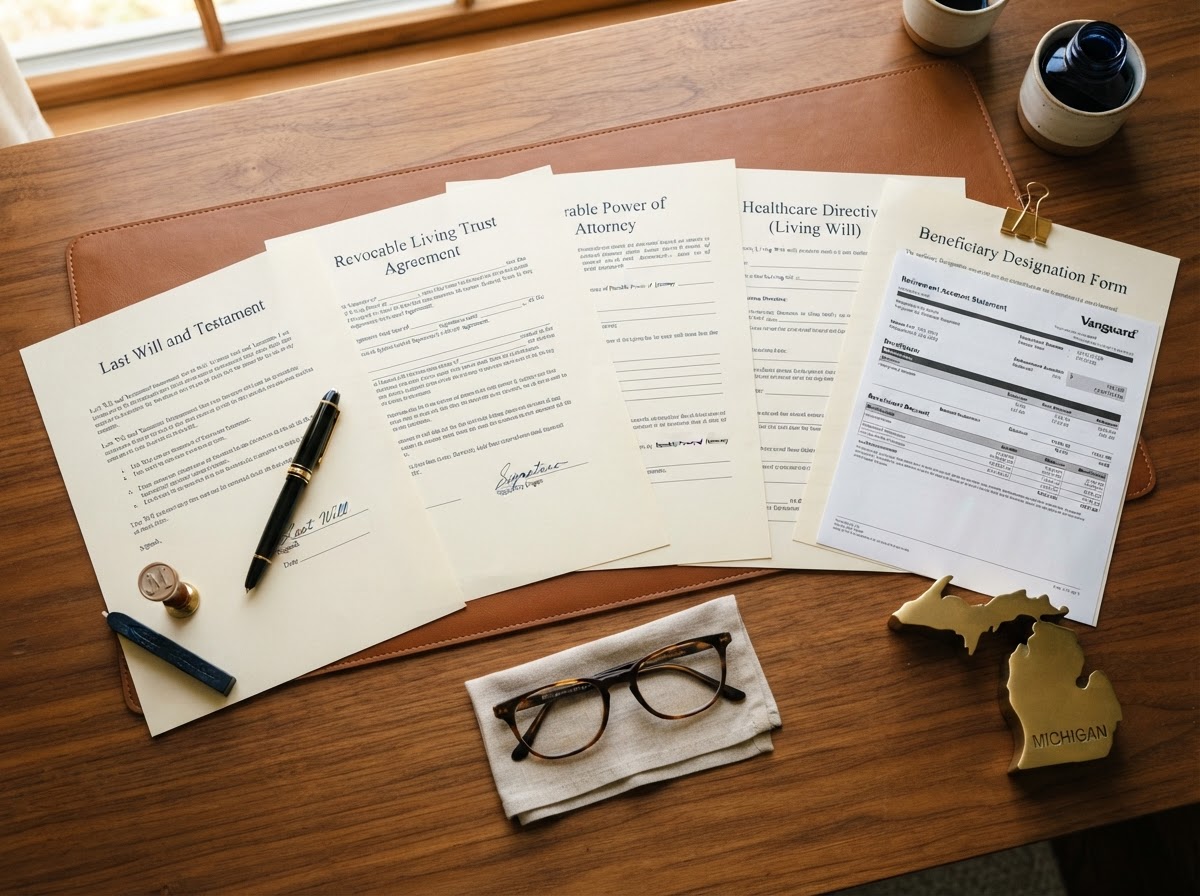
Most retirees in Wayne, Oakland and Macomb counties assume that once they've signed a will, their estate planning is done. It's a reasonable assumption, and it's also the assumption that causes some of the most expensive, most avoidable mistakes families deal with after a loved one passes. A will is one of five documents that actually govern what happens to your money, your property and your care decisions, and the other four are just as important, sometimes more so.
This week is National Estate Planning Awareness Week, which makes it a good moment to walk through what those five documents actually do, in plain language, before you sit down with an attorney to put them in place. None of what follows is legal advice, and it isn't a substitute for that conversation. Think of it as the checklist worth bringing with you: what to have, why it matters and where the most common gaps tend to hide.
The Two Foundation Documents: Will and Trust
A will is the document most people already have, or already know they need. It names who inherits your property, who raises minor children if that applies to your family, and who serves as your personal representative to settle your affairs. What a will doesn't do is avoid probate. In Michigan, an estate that goes through probate can take months to over a year to close, and probate is a matter of public record, meaning anyone can look up what your estate contained and who received it.
A revocable living trust is the document that solves that specific problem. Assets titled in the name of your trust pass to your beneficiaries without probate court involvement at all, on your timeline, privately. A trust isn't automatically necessary for every retiree. It tends to matter more if you own property in more than one state, if your family situation includes a blended family or a beneficiary who needs extra protection, or if avoiding probate and keeping your affairs private is simply important to you. An estate planning attorney can help you decide whether a trust makes sense for your specific situation, or whether a will alone covers what you need.
The Two Decision-Making Documents: Powers of Attorney
A will and a trust both deal with what happens to your assets after you're gone. The next two documents deal with something just as important: what happens if you're still here, but you're temporarily or permanently unable to make decisions for yourself.
A durable power of attorney names someone you trust to manage your finances if you can't, paying bills, managing accounts and handling property decisions on your behalf. Without one, your family may need to petition a Michigan probate court for guardianship just to keep your household running while you recover from a medical event.
The medical equivalent in Michigan is called a Patient Advocate Designation, sometimes referred to elsewhere as a healthcare power of attorney. It names who can make medical decisions for you if you're unable to communicate them yourself, and it tells your care team what you would want. Without it, a decision about your care can end up in front of a judge instead of the person who actually knows your wishes.
The Most Overlooked Document: Beneficiary Designations
Here's the document that trips up more families than the other four combined, and it's rarely thought of as an "estate planning document" at all. Every 401k, IRA and life insurance policy has a beneficiary form on file, and that form determines who receives that specific account when you pass away.
The part that surprises most people: that form overrides your will. Every time. It doesn't matter what your will says about who inherits your retirement accounts. If the beneficiary form still lists an ex-spouse from a prior marriage, someone who has since passed away or doesn't reflect a more recent remarriage, the account goes exactly where the form says, not where the will says. This isn't a loophole. It's simply how these contract-based accounts are structured.
The good news is that this is the easiest of the five documents to fix. Pull your most recent statement from each retirement account and life insurance policy, check the beneficiary section and update anything that no longer reflects your life. A divorce, a remarriage or a death in the family are the three most common reasons a beneficiary form falls out of date. If you retired from an auto industry employer with a pension, the same idea applies to your survivor benefit election, it works on the same principle as a beneficiary form, and it deserves the same periodic check.
Download the Free 5 Documents Checklist
Get a printable PDF version of this checklist to bring to your attorney. Enter your name and email and we'll send it straight to your inbox.
How These Five Documents Fit Your Bigger Retirement Picture
Estate planning doesn't sit off in its own corner of your retirement plan. Your beneficiary designations connect directly to your Medicare and Social Security decisions, your insurance and annuity choices, and how you're drawing down income. When something in your life changes, a remarriage, a new grandchild, moving to be closer to family, it's worth checking whether these five documents, and the rest of your retirement plan, still line up with it.
This is why estate planning is one of the six pillars in the Six-Pillar Retirement Model, alongside Medicare, Social Security, insurance protection and guaranteed income, coordinated as one plan instead of six separate decisions made at six separate times.
Frequently Asked Questions
Do I need a living trust if I already have a will in Michigan?
Not necessarily. A will alone is enough for many retirees. A trust becomes more valuable if you want to avoid Michigan probate, own property in more than one state, or have a more complex family situation. An estate planning attorney can help you decide which fits your circumstances.
What happens if I die without a will in Michigan?
Michigan's intestacy law decides who inherits your property, which may not match what you actually want, and the process still goes through probate court. Having a will keeps that decision in your hands instead of the state's default formula.
Can I update my own beneficiary designations?
Usually, yes. Most retirement account and life insurance providers let you update your beneficiary form directly through your account, no attorney required. The key is remembering to actually do it after a major life change.
What's the difference between a durable power of attorney and a Patient Advocate Designation?
A durable power of attorney covers financial decisions if you're unable to make them yourself. A Patient Advocate Designation, Michigan's version of a healthcare power of attorney, covers medical decisions. Most retirees need both, and they name different people or the same person, depending on your family.
Who should draft these documents for me?
A licensed estate planning attorney should draft your will, trust and powers of attorney. Janine coordinates the estate planning pillar of your retirement plan and can help make sure these documents connect to your Medicare, Social Security, insurance and income decisions, but drafting the documents themselves is an attorney's job.
Ready to Get Your Five Documents in Order?
If you've read through this list and you're not sure where you stand on all five documents, that's exactly what a free Six-Pillar Retirement Review is for. Book yours at LifestyleSafety.com, or call (313) 450-9543. And for the fuller picture of how estate planning fits with the other five pillars of your retirement, get "You Worked Too Hard to Run Out of Money" at LifestyleSafety.com.